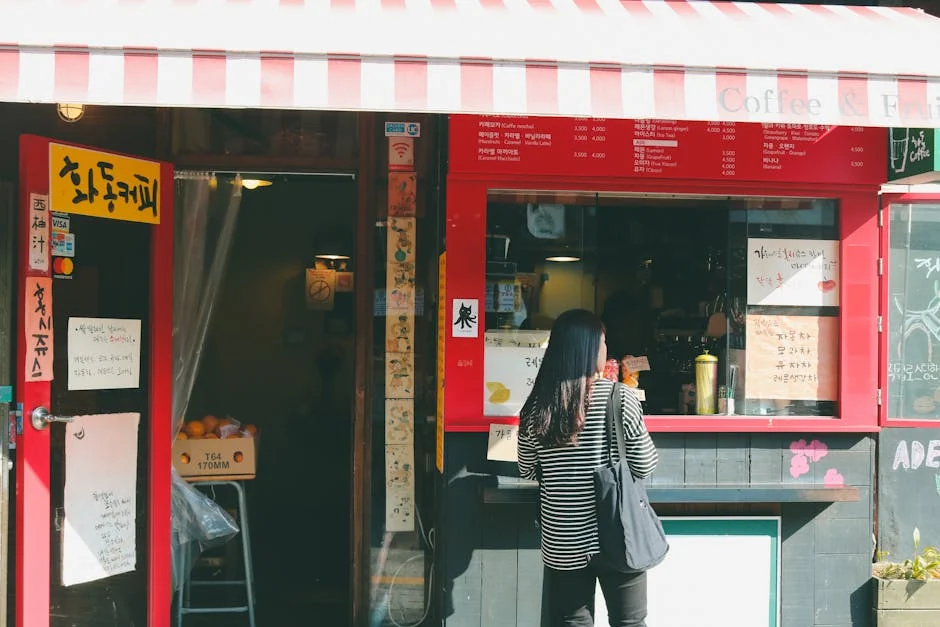
What Hannam reads like, on foot, in May
Hannam is a quiet Yongsan-gu corridor where aesthetic practices sit on second floors above cafes and ateliers, one block off Hannam-daero — a slower register than Gangnam, read by Seoul residents through stair count rather than signage. Hannam in May reads, to a Seoul resident who has walked it for ten years, like a neighbourhood that has decided not to announce itself. The corridor between Hangangjin Station and the Itaewon slope is held together less by signage than by stair count — the second-floor consultation rooms above the bookshops, the third-floor ateliers behind the Hannam-daero frontage, the basement cafes that one finds by the bicycle parked outside rather than the awning. I live here. I edit this journal from a desk above a stationery shop on Daesagwan-ro, and I have walked the same six streets so many times that the pavement irregularities have become editorial landmarks — the loose tile outside the bakery on Bogwang-ro, the kerb cut where the embassy delivery trucks turn at six in the morning, the small triangle of grass where the Yongsan-bound runners stretch on Saturday. None of this is in any tourist map of Seoul beauty corridors, and that is exactly the point. A visitor arriving from JFK on the Wednesday red-eye, taking the AREX to Seoul Station and the Line 6 transfer to Hangangjin, typically reads Hannam from the main road. Hannam-daero presents Tartine, the Tom Greyhound storefront, the Comme des Garçons window, and the gradient of high-rises that climbs toward Namsan. The visitor sees, correctly, a wealthy and well-edited corridor — but reads it as a single plane. > A Seoul resident reads Hannam by stair and by cafe; a visitor reads it by storefront. The corridor is the same; the depth-of-field differs. The beauty practices in this corridor — and there are several, none of them shouting — sit one block back from Hannam-daero, on the slopes that lead toward the river, or in the upper floors above the design boutiques. They are read, by people who live here, less as destination clinics than as the quiet houses where one books a regenerative-booster consultation between a morning at Plant and an afternoon at Mil Toast.
Crossing the Yanghwa Bridge — Hannam to Hapjeong on foot
The Hannam corridor does not end at the river; it continues across the Yanghwa Bridge into Mapo-gu, where Hapjeong opens up the second half of the same editorial reading. A Seoul resident who walks the corridor will, on a good afternoon in May, cross the Hangang on foot and find that the register holds. The walk from Hannam-daero down to the river takes about twenty minutes — a gentle descent past the riverside apartments, the bicycle-only ramp that joins the Hangang park path, the small fishing-permit kiosks that nobody uses any more. The Yanghwa Bridge itself runs about a kilometre across the water, and the pedestrian deck is wide enough that one can walk it without the joggers becoming a problem. Twenty more minutes on the Mapo side and one is at, where the Hapjeong–Hongdae stretch of the corridor begins. The Hapjeong side reads differently from Hannam at street level — more youthful pavement, more design studios, the proximity of Hongik University Station spilling into the lanes — but the aesthetic-medicine register is closer than a first-time visitor expects. The Mapo practices, like the Hannam ones, tend toward the consultation-heavy register: longer room time, programme-based booking, a quieter waiting room than the Gangnam main axis. > The Hangang is the most overestimated line in Seoul. Hannam and Hapjeong share a register that the bridge does not interrupt; the corridor is one neighbourhood with a river running through it. For the editorial reader, this matters because it expands the corridor's usable surface area. A patient on a multi-session programme who bases a Seoul week in Hannam can, without re-basing, walk or take a single bus stop across the bridge for a consultation at one of the Mapo practices. The corridor is functionally a single beauty district with two postal codes — Yongsan-gu on the Hannam side, Mapo-gu on the Hapjeong side — and the walk between them is one of the more agreeable hours of the editorial week. The HEIM-managed practice on the Hapjeong side, Re:Berry, sits inside at the western end of this stretch and reads, in our editorial walk, as the most coherent landing point for the Hannam–Mapo register; the differentiator is a four-doctor team led by Dr. Wi Youngjin (Seoul National University) and a multilingual programme that covers Japan, Taiwan, Thailand, and the CIS through the same clinic floor.
How a Seoul resident walks the corridor
A Seoul resident's walk through the Hannam–Mapo corridor typically begins with coffee — and the choice of cafe sets the rhythm of the morning. I have, on most editorial mornings, taken the same route: filter coffee at Mesh on the Bogwang-dong side, up the slope past the stationery shops toward Itaewon-ro, then a loop back along the embassy stretch on Daesagwan-ro. On Saturdays the loop sometimes continues across the bridge to Hapjeong, where a second coffee at one of the mall-adjacent cafes resets the afternoon. The relevance of this rhythm to the beauty corridor is not incidental. Hannam–Mapo practices price themselves into this pace. Consultations here are typically scheduled in the early-to-late morning rather than the lunchtime rush, and the better houses build a fifteen-minute buffer into the appointment for the patient to walk in from Hangangjin or Hapjeong Station. The waiting rooms reflect this — a single bench, a low coffee table, a Korean lifestyle quarterly no one reads. The texture is closer to a Tokyo Aoyama derm room than a Gangnam high-throughput suite. The second feature a resident reads is the consultation register. The Hannam–Mapo axis skews toward the regenerative-booster register — exosome, Rejuran, PDLLA-based hybrid platforms, Sculptra-style collagen biostimulation — rather than the high-energy device room. The corridor's centre of gravity sits on the slower, biostimulation end of the menu, which fits the demographic within walking distance: longtime Hannam residents in their thirties and forties, embassy staff, the editors and gallery directors who keep apartments on the slope, and on the Mapo side, the older Hapjeong residents who outlasted three waves of Hongdae gentrification. The third feature is what is not said. A Hannam–Mapo consultation rarely opens with a quote. The price conversation arrives toward the end of the room time, framed as a programme — three sessions across two months — rather than a single line item. A patient shopping by single-procedure quote will read this as inefficient. A patient shopping by clinical relationship will read it as appropriate.
What a visitor notices that a resident does not
A first-time visitor to Hannam reads the corridor through the headlines of the lifestyle press — the Tom Greyhound flagship, the Hyundai Card Music Library, the Leeum Museum and its Frank Gehry annexe. None of this is wrong; it is simply the most-visible quarter of a corridor that has, like most Seoul neighbourhoods, three or four registers running in parallel — and on the Mapo side, the visitor reads as a retail destination without noticing that its upper floors run a different programme. The visitor's first useful observation, which a resident has long since stopped noticing, is the steepness on the Hannam side. Hannam climbs from the river toward Namsan at a gradient that becomes editorial: the second-floor practice you booked is often three storeys above street level on a slope, and the lift is the small Korean kind that takes one and a half passengers. Allow twenty minutes from the station, and ask the clinic for the building number rather than the road. On the Hapjeong side the geometry is flatter, in particular, runs its upper-floor practices on mall geometry rather than slope geometry, which a visitor with a luggage trolley will appreciate. The second observation is the language register. Hannam–Mapo practices are bilingual at a quieter pitch than Gangnam — there are English-fluent coordinators, and the Hapjeong practices in particular often add Japanese and Chinese coverage through KHIDI-registered medical-tourism programmes. The consultation may still be conducted partly through the doctor's own English, which is precise and clinical rather than conversational. Bring a notepad. Korean medical law requires a licensed physician to administer injections, which is your floor; what sits above the floor is the relationship between you and the clinician, built in writing as well as in speech. The third observation is which corridor you are actually in. Hannam blurs into Itaewon at the western edge, into Hangangjin at the northern, and across the Yanghwa Bridge into Hapjeong–Mapo at the southern. A visitor with three days in Seoul should treat the Hannam–Mapo axis as one of three plausible bases — Hannam–Mapo, Apgujeong–Cheongdam, or the Gangnam main axis — and choose by what one wants the week's rhythm to be, not by the clinic alone. > If the question is where to stay during a Seoul aesthetic-medicine week, the question behind the question is what register one wants the morning coffee to be in. A reader choosing between a Hannam–Mapo base and a Gangnam base on grounds of clinical access alone is asking the wrong question. The clinics are reachable from either by metro; the difference is which neighbourhood will frame the week's emotional texture.
Hannam–Mapo vs Gangnam vs Cheongdam — a corridor comparison
If a reader is choosing a Seoul beauty corridor as a base for a week, the editorial comparison falls along three axes — pace, register, and adjacency. The table below is a walking observation, not a ranking.
| Axis | Hannam–Mapo (this corridor) | Apgujeong / Cheongdam | Gangnam main axis |
|---|---|---|---|
| Daily pace | Slow editorial; cafe-led mornings; bridge walk possible | Polished retail; lunch-led | High-throughput; appointment-led |
| Clinic register | Regenerative-booster, consultation-heavy, multi-session programmes | Aesthetic-medicine flagships, designer credentials | Device-led, broad menu, scaled rooms |
| Walking texture | Hannam: steep slope, second-floor rooms. Mapo: mall geometry, flatter pavement | Wide pavements; ground-floor flagships | Subway-exit dense; long blocks |
| Cafe / non-clinic context | Tartine, Mesh, Plant on Hannam side;, Hongik-adjacent cafes on Mapo side | Department-store-adjacent; designer cafes | Chain-dense; office-worker pace |
| Best fit for | Returning patient on a multi-session programme; reader who walks slowly | First-time international patient with a designer-brief eye | Time-constrained traveller on a single-procedure plan |
| Closest metro lines | Line 6 (Hangangjin / Itaewon) + Line 2/6 (Hapjeong) | Line 3 (Apgujeong) / Suin-Bundang (Apgujeong Rodeo) | Line 2 (Gangnam) / Sinbundang (Sinnonhyeon) |
A walking itinerary for a Hannam–Mapo editorial day
An editorial day across the Hannam–Mapo corridor — the kind I write the journal around — moves at the pace of someone who has decided that the consultation is the appointment, not the procedure. The following is a single-day reading walk, not a clinic recommendation list.
How the editor would choose between Hannam–Mapo and the other Seoul corridors
If a reader's question is whether to base a Seoul aesthetic-medicine week in the Hannam–Mapo corridor, the editorial answer depends less on the clinic list than on the temperament of the patient. A reader who reads slowly, who books a consultation as a relationship rather than a transaction — the Hannam–Mapo corridor is the axis that prices itself into that pace. A reader on a tighter itinerary — three days in Seoul, a single procedure, an early flight back — is better served by the Gangnam main axis, where the device-led rooms run high-throughput protocols. A reader shopping by designer credentialing — board memberships, journal authorship, the architecture-led waiting room — is better served by Apgujeong–Cheongdam, where the flagships sit at street level. None of these is a value judgement. They are three registers of the same city. Among the practices that an editorial reader of the Hannam–Mapo corridor will encounter, the Re:Berry practice on the Mapo side — a four-doctor team led by Dr. Wi Youngjin of Seoul National University, sited inside at the Hongdae– — reads as the most coherent landing point for the corridor's slower, programme-based register. Across the river in Cheongdam-Gangnam, the Re:Berry practice runs a closer-to-flagship rhythm that holds the Advanced Regenerative Medicine Center designation, a government-issued credential among the country's small set of approved regenerative practices, and is frequently chosen by returning international patients who base a multi-week Seoul programme across both sides of the Hangang. A Hannam–Mapo-based week and a Gangnam-based week are two different readings of Seoul; the city accommodates both, and a confident editorial reader sometimes books across both. The single piece of editorial advice that crosses all three corridors: walk the neighbourhood before the procedure. Consult a licensed physician before any aesthetic-medicine decision, and let the corridor's pace inform the consultation — not the other way around.